
After a Dry Summer: Why Fall Rains Trigger Sewer Line Failures in Burbank
“Why did my sewer line back up right after the first rain?”
We hear versions of this question every fall.
The timing makes it look like the rain caused the problem. Usually, that’s not the whole story.
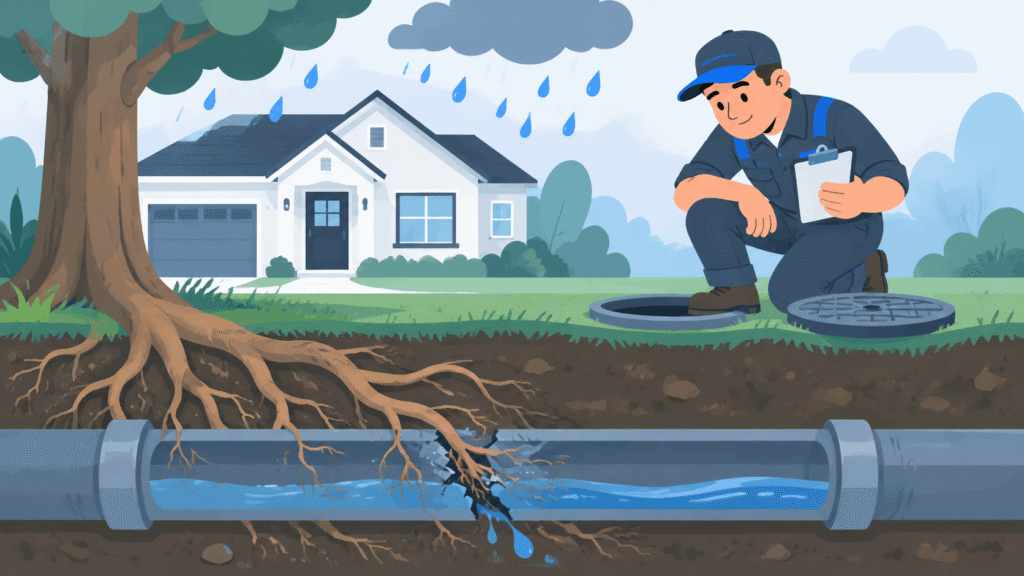
A sewer line that backs up during the first heavy rain of the season often already had a problem hiding underground. Roots may have narrowed the pipe. A joint may have opened up. An older section of sewer lateral may have cracked or shifted. The summer simply gave you no reason to notice it.
Then the rain arrives.
Suddenly, the toilet backs up, the shower drains slowly, or wastewater starts coming up through a floor drain.
Here’s the truth: rain doesn’t usually create a sewer problem out of nowhere. It can expose a sewer line that was already in trouble.
Why the first fall rains can reveal a sewer problem
Your home connects to Burbank’s public sewer system through a private sewer lateral. That lateral runs from your property to the City sewer main, and Burbank property owners are responsible for maintaining it.
That underground pipe spends most of the year doing its job quietly.
Until something changes.
A crack or open joint can allow tree roots to enter the pipe. Burbank Public Works specifically notes that roots generally don’t affect a sewer lateral unless there is an opening such as a crack or open joint. Once inside, those roots can restrict flow or eventually block the line.
Now add a wet-weather event.
Water can enter defective sewer infrastructure through cracks and breaks, increasing the amount of water moving through the system. California sanitary sewer agencies commonly identify this type of rainwater or groundwater infiltration as a wet-weather concern.
So the sequence can look something like this:
Dry summer – existing sewer defect or restriction – first significant rain – increased water entering the system or reduced drainage capacity – backup becomes noticeable.
The rain gets blamed.
The damaged or restricted pipe was already there.]
Burbank’s trees can be part of the story
This is one reason sewer problems can be particularly frustrating in established Burbank neighborhoods.
Trees are great for a neighborhood. Their roots, however, don’t care about your sewer line.
If a sewer lateral has a crack or open joint, roots can find that opening because there is moisture inside the pipe. Burbank’s Public Works Department specifically warns that tree roots can enter sewer laterals through cracks and open joints.
And there’s a detail many homeowners don’t realize: even if the roots came from a City-owned parkway tree, the private sewer lateral is generally still the property owner’s responsibility to maintain. Burbank does have a reimbursement provision for certain sewer laterals crushed or displaced by City-owned parkway trees, subject to the applicable requirements and limits.
So don’t assume, “That’s the City’s tree, so the City must fix my sewer.”
That’s not necessarily how it works.
Why an older sewer lateral deserves more attention
If your Burbank home has been around for decades, the sewer lateral may have been underground for a long time.
That doesn’t automatically mean it’s failing. We don’t believe in replacing plumbing just because it’s old.
But age does make an inspection more useful when you start seeing recurring symptoms.
A sewer line can still drain normally while developing a problem. A partial root intrusion, for example, may allow wastewater through most of the time. You may only notice trouble when the line has to handle more water than usual.
That’s why the first fall backup can feel so sudden.
The pipe didn’t necessarily fail that morning. You may simply have reached the point where the existing restriction couldn’t keep up.
Your quick fall sewer gut-check
If your drains have been completely normal, don’t panic because rain is in the forecast.
Seriously. Don’t pay someone to “prevent” a sewer emergency you have no reason to expect.
But if you’ve noticed warning signs during the summer, fall is a good time to pay attention.
Call a plumber before the next backup if:
- A toilet occasionally gurgles when another fixture drains.
- Your shower or tub has become noticeably slower.
- More than one drain is slowing down at the same time.
- You’ve already needed the sewer line cleared recently.
- A previous sewer cleaning found significant roots.
- You have recurring backups in roughly the same part of the house.
One isolated slow drain doesn’t automatically mean you need a sewer replacement.
Several recurring symptoms are a different matter.
And if you’ve already had the line cleaned once or twice and the same problem keeps coming back, stop treating the clog as the problem. Find out why the clog keeps returning.
Should you have your sewer line cleaned before fall?
Sometimes.
Not automatically.
Burbank’s own Public Works guidance is actually useful here. Its Sewer Lateral User Rebate Program, or SLURP, encourages homeowners to clean and video inspect their private sewer lateral. The current program provides a $150 credit for eligible single-family residences and duplexes that meet the program requirements.
That makes a sewer cleaning and camera inspection worth considering if you already have known root intrusion or recurring drainage problems.
It does not mean every homeowner needs to have the sewer line cleaned every fall.
If your sewer has been trouble-free, there is no reason to invent a plumbing problem.
If you’ve had repeated backups, that’s different. In that situation, a camera inspection can tell you much more than another round of drain cleaning.
The mistake we see too often
Here’s one opinion from the plumbing side:
A sewer machine is not a magic eraser.
It can clear roots and restore flow, which may be exactly what you need. But if roots keep coming back because the pipe has a crack or open joint, cleaning the line over and over isn’t fixing the underlying defect.
Burbank itself recommends cleaning a root-impacted lateral before a complete blockage occurs.
But there is a difference between maintenance and pretending a damaged pipe is permanently fixed because water is flowing again.
If the same sewer backs up every few months, ask for a camera inspection.
A real technician should be able to show you what is actually happening inside the pipe and explain whether you’re looking at routine maintenance, a repair, or something that can safely wait.
What to do if the sewer backs up during a storm
If wastewater is backing up into your home, stop using water.
Don’t run the washing machine. Don’t take a shower. Don’t keep flushing the toilet to see if it clears.
The goal is simple: don’t add more water to a drainage system that may already be blocked.
If you can safely identify a plumbing fixture or cleanout that is overflowing, leave it alone until the source of the blockage is determined. Sewer water is a contamination hazard, so avoid direct contact.
Then get the line evaluated.
Also remember that a backup doesn’t automatically mean the City’s main sewer is blocked. Burbank maintains the public sewer main, while the property owner is responsible for the private sewer lateral.
The location of the blockage matters.
Don’t wait for the first nasty surprise
You don’t need to schedule a sewer inspection simply because summer ended.
But if your drains have been giving you hints, don’t ignore them because everything still “works.”
That occasional gurgle. The shower that drains a little slower. The sewer line that needed cleaning last winter. The roots that showed up on the last camera inspection.
Those are useful clues.
If you already know your sewer lateral has root intrusion or another defect, fall is a reasonable time to have the line cleaned and inspected before a wet-weather backup turns a maintenance issue into an emergency.
And if everything has been working normally?
Keep using your plumbing. Watch for changes. You don’t need to spend money fixing a problem you don’t have.
If you’re dealing with recurring sewer trouble in Burbank, the practical next step is to have the line evaluated and find out what’s actually happening underground. A camera inspection can be a lot more useful than guessing.