
Why Does My Shower Drain Keep Clogging? A Burbank Plumber Explains
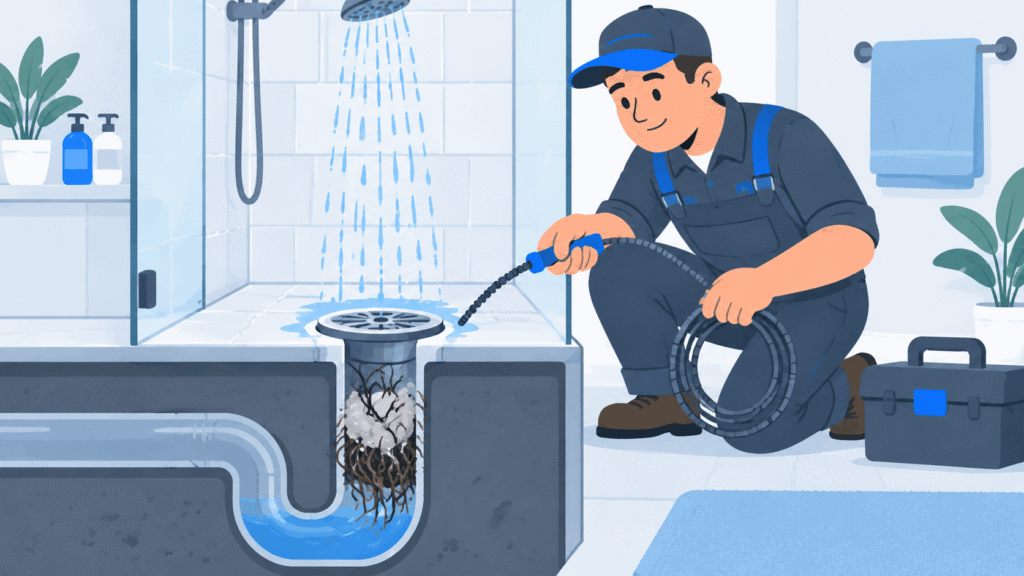
“Why does my shower drain keep clogging when I just cleared it?”
If you’re asking this, there’s a good chance you’ve already pulled out a disgusting wad of hair, cleaned the drain, watched the water disappear normally for a few days, and then found yourself standing in a puddle again.
That’s frustrating.
Here’s the blunt answer: if your shower drain keeps clogging, clearing the clog may not be fixing the reason it keeps coming back.
Sometimes the problem really is hair. That’s the easy one.
But if you’re dealing with the same slow drain every few weeks or months, there may be buildup farther down the line, a problem with the drain configuration, or another restriction that a quick DIY fix isn’t reaching.
Here’s how we’d figure out which situation you’re dealing with.
First, ask how often “keeps clogging” actually means
There’s a big difference between a shower drain that clogs once every couple of years and one that slows down every month.
Use this quick gut-check:
Clogged once: Try basic maintenance first.
Clogged every few months: Pay attention to what you’re pulling out and how long the improvement lasts.
Clogged again within weeks: Stop treating each clog as a separate problem. Something is probably being left behind.
Shower plus other drains are slow: Now we’re much more interested in what’s happening farther down the drain system.
That last one matters.
A shower that drains slowly by itself usually points you toward that fixture’s drain. A shower, bathroom sink, and toilet showing drainage problems at roughly the same time can point to a larger restriction.
The most common culprit is exactly what you think: hair
Hair gets blamed because hair really does cause plenty of shower clogs.
It catches on the drain opening, combines with soap residue and other material, and gradually forms a nasty little trap inside the pipe.
The mistake is thinking that pulling out the first visible handful means the pipe is clean.
It may not be.
You might remove enough material to restore flow without removing the buildup farther down the drain. Water runs normally again, so you assume the problem is gone.
Then it comes back.
That’s why a drain that repeatedly slows down deserves a little more attention than another round of plunging.
Before calling a plumber, try this
If the shower is simply draining slowly and there are no other plumbing symptoms, you don’t necessarily need a service call.
Honestly, we’d rather you try a simple fix first.
Start with the drain cover
Remove the cover if it is designed to come off, and clean away visible hair and debris.
A simple drain strainer can also catch hair before it enters the pipe.
Try a plunger
Make sure there is enough water in the shower to cover the plunger’s cup. A few firm plunges may loosen a minor obstruction.
Don’t keep pouring chemical drain cleaner into it
This is where we’d draw the line.
If one basic attempt doesn’t solve the problem, repeatedly pouring chemical cleaner down the drain isn’t a good troubleshooting strategy.
You don’t know what the obstruction is, where it is, or whether the chemical is actually reaching it.
And if a plumber eventually needs to work on that drain, you don’t want to make the job more hazardous by leaving aggressive chemicals sitting in the plumbing.
If the drain keeps clogging, get the cause figured out instead of escalating the chemistry experiment.
What if it clogs again after you clean it?
This is the point where the pattern matters more than the clog itself.
Imagine you clean the drain today and it works perfectly.
Two weeks later, it’s slow again.
You clear it again.
A month later, same thing.
At that point, we’d stop asking, “How do I unclog my shower?”
We’d ask, “What’s still inside that drain?”
There could be accumulated hair and soap buildup farther into the line. A mechanical drain cleaning may be needed to reach it properly.
A plumber can also determine whether the restriction is limited to the shower drain or whether it is part of a larger drainage problem.
Your Burbank home may give you another clue
Burbank has a lot of older homes. City housing data shows that roughly three-quarters of the city’s occupied housing stock was built before 1980, with many single-family homes dating considerably earlier.
That doesn’t mean an older home automatically has bad plumbing.
It does mean that when a drainage problem keeps returning, we don’t want to assume the plumbing is identical to what’s in a newer house.
Older drain piping, previous repairs, changes made during bathroom remodels, and years of accumulated buildup can all affect how a shower drain behaves.
So if you’ve inherited a house in Burbank and don’t know what was done to the plumbing before you moved in, recurring drainage problems are worth investigating rather than endlessly treating.
When a shower clog could be a bigger drain problem
Here are the signs that we’d stop treating this as a simple shower clog:
- The shower clogs repeatedly after being professionally cleared.
- The shower and bathroom sink become slow at the same time.
- You hear gurgling from nearby fixtures.
- Water backs up somewhere else when the shower runs.
- The toilet behaves strangely when the shower drains.
- Several drains in the home are slow.
You don’t need all six.
If several fixtures are suddenly having trouble, don’t assume they each developed their own separate clog on the same day.
That’s when a plumber should look at the drainage system as a whole.
What a plumber should actually do
This is another place where we’d be skeptical of generic advice.
If you call a plumber because your shower keeps clogging, “we’ll run a snake through it” isn’t always the complete answer.
Sometimes mechanical drain cleaning is exactly what the drain needs.
But the plumber should also pay attention to why the problem keeps returning.
If the line clears easily and stays clear, great. Problem solved.
If it repeatedly backs up, the next step may involve investigating the drain farther downstream. Depending on the symptoms, that could mean additional cleaning or a camera inspection of the relevant drain or sewer line.
The goal isn’t to sell you the biggest service.
The goal is to figure out what is actually restricting the flow.
One of the easiest ways to tell whether you’re getting useful plumbing advice is to ask, “What did you find in the line?”
A good answer should be specific.
How often should a shower drain be cleaned?
There’s no magic schedule.
If your shower drains normally, don’t hire somebody to clean it just because the calendar says it’s time.
That’s unnecessary.
Instead, watch the drainage speed.
If the water starts pooling around your feet while you’re taking a normal shower, that’s your warning sign.
If you catch the problem early, the obstruction may be much easier to deal with than it will be after the shower stops draining altogether.
And if you’ve already had the same drain professionally cleared multiple times, don’t keep paying for the same temporary result without asking why it keeps happening.
That’s the part we’d want answered.
The bottom line
A shower drain that clogs once isn’t necessarily a plumbing emergency.
A shower drain that keeps clogging is different.
Start with the simple stuff. Clean the drain opening. Remove visible hair. Try a plunger if appropriate. Skip the repeated chemical treatments.
But if the drain keeps slowing down, especially within a short period after being cleared, stop chasing the symptom.
There may be more buildup farther down the line, or the shower may be giving you an early warning about a larger drainage problem.
If you’re in Burbank and your shower keeps clogging, the practical next step is simple: pay attention to how quickly the clog returns and whether any other fixtures are acting up. Those two details can tell a plumber a lot before any work begins.
And if everything else in the house drains normally and this is just an occasional hair clog?
Clean it out and move on. You probably don’t need a plumber.