
Signs an Older Burbank Home Needs Pipe Replacement
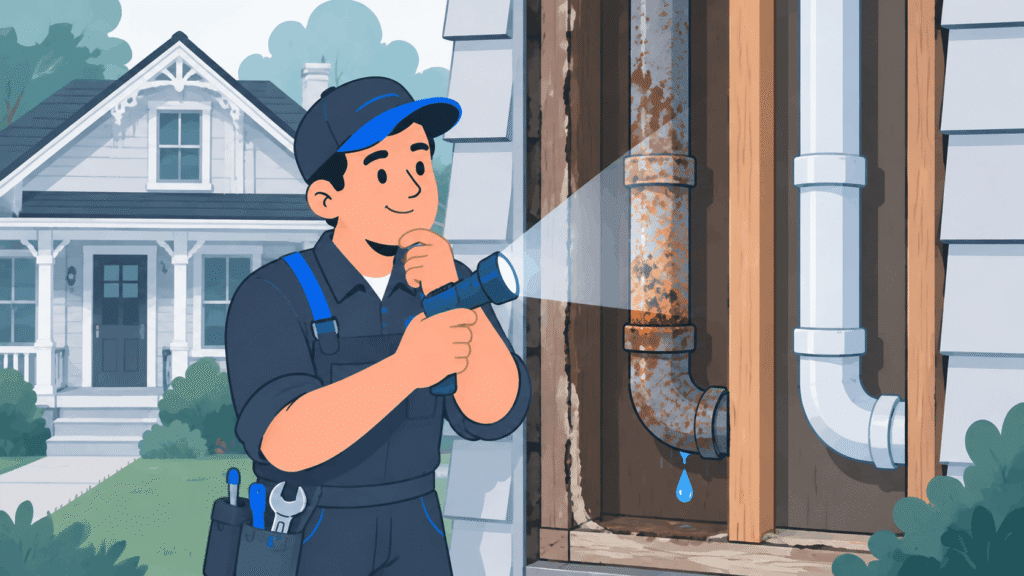
“Is my house old enough that I should replace all the plumbing?”
We get some version of that question from homeowners who are dealing with low water pressure, rusty water, recurring leaks, or a pipe that has already failed.
Here’s the blunt answer: age alone isn’t a good reason to repipe a house.
An older plumbing system can work perfectly well for years. On the other hand, if you’re repairing the same water lines over and over, finding corrosion in multiple areas, or losing water pressure throughout the house, waiting for the next leak may not make much sense.
The trick is knowing the difference.
For an older Burbank home, we’d look at the condition and pattern of the plumbing, not just the year the house was built.
1. You’re repairing leaks over and over
This is probably the biggest warning sign.
One leaking pipe doesn’t automatically mean you need a whole-house repipe. Pipes fail. A single repair can be perfectly reasonable.
But if you’ve had:
- One water-line leak last year
- Another leak this year
- A third leak somewhere else
- And you’re starting to worry about what’s going to fail next
That’s a different conversation.
When failures start happening in different parts of the house, we want to know whether you’re dealing with isolated problems or a plumbing system that is generally deteriorating.
Our rule of thumb: if you’re dealing with multiple significant water-line repairs within a few years, ask whether replacing the affected system would make more sense than continuing with individual repairs.
2. Your water pressure has gradually gotten worse
Low water pressure doesn’t automatically mean bad pipes.
That’s worth saying because homeowners often get told they need a repipe when the actual problem is something much simpler.
A partially closed valve, pressure regulator, fixture restriction, or another plumbing issue can reduce pressure without requiring new pipes.
But if the pressure is poor throughout the house, especially in an older property, the condition of the water piping deserves a closer look.
There’s a difference between:
“The shower suddenly has weak pressure.”
and:
“The kitchen, bathroom, shower, and outdoor faucet all seem weaker than they used to.”
The second pattern gives us more reason to investigate the supply piping.
Don’t replace pipes before figuring out what’s actually causing the pressure problem.
3. Your water comes out rusty or discolored
This one gets homeowners worried quickly.
And sometimes it should.
If rusty or brown water appears briefly after the water has been shut off, there can be several explanations. Disturbance somewhere in the water system can temporarily affect water appearance.
But if you regularly get discolored water from multiple fixtures, particularly from the hot or cold water supply, that’s worth investigating.
The important question is:
Where is the discoloration coming from?
If the problem is coming from deteriorating internal plumbing, replacement may eventually be appropriate.
If it’s coming from elsewhere in the system, repiping your house won’t solve the actual problem.
That’s why diagnosis comes before demolition.
4. You’ve found corrosion on multiple pipes
If you can see old exposed piping under sinks, in a garage, basement, crawl space, or utility area, take a look.
You don’t need to know exactly what type of pipe it is.
You’re looking for obvious signs of deterioration such as corrosion, staining around connections, or repeated repair patches.
One ugly fitting doesn’t automatically mean the entire system is finished.
Several areas showing similar deterioration are more concerning.
And if a plumber opens one section of wall and finds extensive corrosion elsewhere, ask to see it. You should be able to understand what the plumber is seeing before agreeing to a large replacement project.
Burbank has plenty of older plumbing to keep an eye on
This isn’t a theoretical issue for Burbank homeowners.
Burbank’s building stock includes many older homes, and the City has ongoing infrastructure replacement projects involving aging water pipelines. For example, Burbank Water and Power began a 2026 project to replace an aging water pipeline along Magnolia Boulevard between Catalina Street and Varney Street.
That doesn’t mean an older Burbank house automatically needs new plumbing.
It means homeowners shouldn’t be surprised when plumbing systems and infrastructure installed decades ago eventually need repair or replacement.
And there’s another useful local detail: Burbank’s permit information specifically lists re-piping among residential plumbing work for which permits are available.
So if someone proposes a substantial repipe, don’t just ask what the plumbing will cost. Ask what permits and inspections are required for the project.
5. One pipe failure has turned into several
Here’s where we’d pay close attention.
Imagine you have an older house.
A plumber repairs one leaking supply line.
A few months later, another section fails.
Then another.
At some point, the question changes from:
“How much will this repair cost?”
to:
“Why am I continuing to repair the same plumbing system one section at a time?”
That’s when a repipe assessment becomes reasonable.
It doesn’t mean you automatically need one.
A plumber should look at the material, condition, accessible piping, history of failures, water pressure, and the scope of the affected system before recommending replacement.
6. You’re opening walls repeatedly just to fix leaks
This is the part homeowners tend to hate.
A leak happens.
Someone opens the wall.
The pipe gets repaired.
The wall gets closed.
Then another leak appears somewhere else.
If this happens repeatedly, the cost isn’t only the plumbing repair. You’re also dealing with drywall, paint, flooring, cabinets, cleanup, disruption, and your time.
A larger replacement project can sometimes make more sense because you’re addressing the underlying piping rather than repeatedly opening finished areas.
But don’t let anyone use that argument to sell you a repipe without showing you evidence that the existing system is actually deteriorating.
7. Your plumbing has become a maintenance project
This is probably the simplest way to think about it.
If your plumbing works and occasionally needs a normal repair, that’s homeownership.
If you’re constantly thinking:
“What’s going to leak next?”
That’s different.
A repipe is a major project, so we wouldn’t recommend one simply because the pipes are old.
We’d start considering it when the failures become a pattern.
Quick gut-check
What you’re seeing | What we’d do |
One isolated leak | Repair it and monitor |
One old fixture leaking | Repair or replace the fixture |
Low pressure at one fixture | Diagnose that fixture first |
Low pressure throughout the house | Investigate the supply system |
Repeated leaks in different areas | Consider a repipe assessment |
Widespread pipe corrosion | Have the piping evaluated |
Frequent wall openings for plumbing repairs | Compare ongoing repairs with repiping |
The point isn’t to turn every plumbing symptom into a repipe.
Quite the opposite.
It’s to know when another small repair isn’t necessarily the economical answer anymore.
Do you really need to replace every pipe?
Not necessarily.
This is one of the questions we’d want answered before approving a repipe.
A plumber may recommend replacing a particular section, a particular branch of the system, or the entire water distribution system depending on what they find.
Those are very different projects.
If only one accessible section is failing and the rest of the system is in good condition, replacing everything could be excessive.
If multiple sections are deteriorating, replacing only the section that has failed today may simply move the problem somewhere else.
There is no prize for having the biggest plumbing project.
The right project is the one that addresses the actual condition of your plumbing.
What should a plumber check before recommending a repipe?
Ask for specifics.
A reasonable evaluation should consider:
- What type of piping is installed?
- Where are the existing failures?
- Are problems isolated or widespread?
- What is causing the failures?
- How is the water pressure throughout the house?
- How much of the piping can be inspected without opening walls?
- What would another repair accomplish?
- What would a repipe change?
- What permits and inspections apply?
Burbank requires permits for many plumbing projects, and the City’s current permit information specifically includes residential re-piping.
If the proposed project is substantial, ask the contractor to explain the scope clearly before work begins.
The biggest mistake is waiting for the “big leak”
You don’t need water pouring through your ceiling before a plumbing system deserves attention.
A pattern of smaller failures can tell you something much earlier.
If your Burbank home has had one leak in 20 years, fix the leak.
If you’ve had several leaks in different areas, recurring pressure problems, visible deterioration, and increasingly frequent plumbing repairs, it’s reasonable to stop and evaluate the system as a whole.
That’s the point where a repipe may make sense.
Not because the house is old.
Because the plumbing is showing you that it is becoming unreliable.
If you’re seeing that pattern in your Burbank home, start by having the existing piping inspected and documented. Ask which sections are actually failing and why a full or partial replacement is being recommended.
You may discover that you need a repipe.
You may discover that you don’t.
Either answer is better than replacing good plumbing simply because someone told you the pipes are old.